Showing posts with label Montreal. Show all posts

July 22, 2022

Provincial Transport circa 1967 - Montreal Facilities


This article probably appeared in a magazine promoting Montreal's various industries and attractions during Expo 67. The article is translated into French below the English version. Additional languages used for the captions are Spanish, Italian and German. 

Perhaps the periodical was prepared for international Expo 67 tourists, but intended to still have a 'shelf-life' for a year or two afterwards.

The bus terminal was a block north of CPR Windsor Station at Drummond and Dorchester. Provincial Transport operated a service along Highway 20 on Montreal's west island - so most of the trips taken by family members were related to this route.


November 30, 2019

1967 CFCF 600AM Radio

Here are a few more artifacts from CFCF 600 AM Radio in Montreal (others can be found in the Culture index).

Probably when I was about six years old, my father bought me a crystal radio kit with a blue plastic case, a pre-wound tuner and a pre-mounted crystal as a Christmas present. He suggested CFCF as a station I could listen to. Sadly, I missed the dynamic French-language music scene of that era. However, not knowing any French, I didn't know what I was missing until I was aged 35 or so - long after we moved to Ontario.

Below: A stack of these free hit charts would usually be placed near the cash register of record stores. Each week, in many stores, 45 RPM singles would be dutifully rearranged on pegboard-based holders in the order they appeared on these lists. In Lachine, two nearby stores provided this essential service - one near the bottom of 45th Avenue and another at the south end of the Dorval Shopping Centre. 

In the years before 'Canadian Content' requirements, you'll notice how few of the tunes are marked 'Canadian'. 

My mother gave us piano lessons so we all had an appreciation for classical music and easy-to-play United Church hymns before completing elementary school. Seasonally, the Hallelujah Chorus of 'The Messiah' was prescribed and pounded out with a considerable lack of musicianship by me. My siblings have both been church organists, one runs a Master's piano program at an arts college, the other can improvise any piece on a piano.

... I ... have a collection of contemporary 45 RPM records from these hit charts.

Perhaps because he regularly visited the Bank of Commerce on the nearby corner of 45th Avenue, my father always insisted on picking up any 45 RPM requests I had come up with. 

At about the time this particular chart was issued, "geezer" was a popular general-purpose term for older males, and was in common use by boys attending Meadowbrook School. And Batman, starring Adam West, was a popular show with that same cohort. One fine day, a boy in my class named Peter told me there was a new song I should get, entitled Geezer Batman. I passed the request on to my father, and this local high school teacher of History and English, a graduate of Queen's University, walked into that store on 45th and asked for Geezer Batman. He was sold a copy of Number 60, on the chart below. My father (naturally understanding the historical reference and military terminology) was quite amused as he later provided me with the correct title and my new 45.


Above: the exterior.


Above: the interior.

I was fascinated to notice that the kids in the photo above are boarding a Lockheed Constellation. Below, I have enhanced/enlarged the photo a little because it is my experience that I will someday be contacted by someone who was there. 

A piston-engined aircraft filled with excited kids would make for quite a noisy flight. It is certain that the relative novelty of flight (for people back then) would ensure that many faces were pressed to the windows.

Historical tangent:

That particular Lockheed Constellation CF-NAL was with Nordair from 1964 to 1969. Later it was ferried to Sao Tome (an island off today's Gabon), to be used during the Biafran Airlift.

The same Lockheed Constellation later became part of the Restaurant Piano Bar Asas d'Avião, at Sao Tome airport.
Screen grab Nov 2019.


Above: the photo enlarged a little.

*  *  *

By sending in breakfast cereal boxtops ('proof of purchase') or just by composing letters outright, many kids had fun experiences getting free stuff through the mail.


I wrote a letter and received a 12 inch by 16 inch poster of CFCF's DJ's and other on-air talent.
It arrived in the envelope above - I have cleaned the label of my name/address.

Some of you may already know some of the people shown ...

  • I usually listened to Al Boliska from about 06-07hr, weekdays. Immediately before coming to CFCF, I think he worked in Kingston. He was excellent.
  • Dave Boxer was the well-loved evening DJ with a cool, distinctive style who played the hits for the Baby Boomers. Sometimes there were listener call-in features: e.g. 'The Monkees were given a TV show, why can't the Beatles get one?'
  • Bill Haughland read the news.
  • Derek Lind provided traffic reports from CFCF's little Hughes helicopter (see the Model 200 for an approximation). It was regularly seen at the top of our street as it patrolled along the '2 and 20'.

A future post will include CFCF ads/articles from the Montreal Star.


August 21, 2019

Montreal Skyscrapers 1961 - photographed by George Gagnon

Probably following my father's technological lead, my grandfather began to take snapshots using colour slide film in the early 1960s. A number were taken to document the progress of the construction of his retirement chalet at Lac Saguay:


Here is a display of his snapshots taken of the other end of the architectural scale. He photographed a number of Montreal's skyscrapers as they were being built in 1961.

A number of these slides have the typical red/brown cast resulting from flawed processing techniques of the era - they're almost entirely devoid of blue and green shades. Where you see black edges, I have straightened the photo while trying to preserve interesting corner details which might otherwise be lost during the cropping process. The images are generally captioned with my father's description of them after my grandfather's death.


Student Christian Movement on Oxenden Street - renamed Aylmer Street.


From McGill campus looking south.


Guy and Sherbrooke Streets, looking east.


Construction of the Standard Life building, Sherbrooke Street.


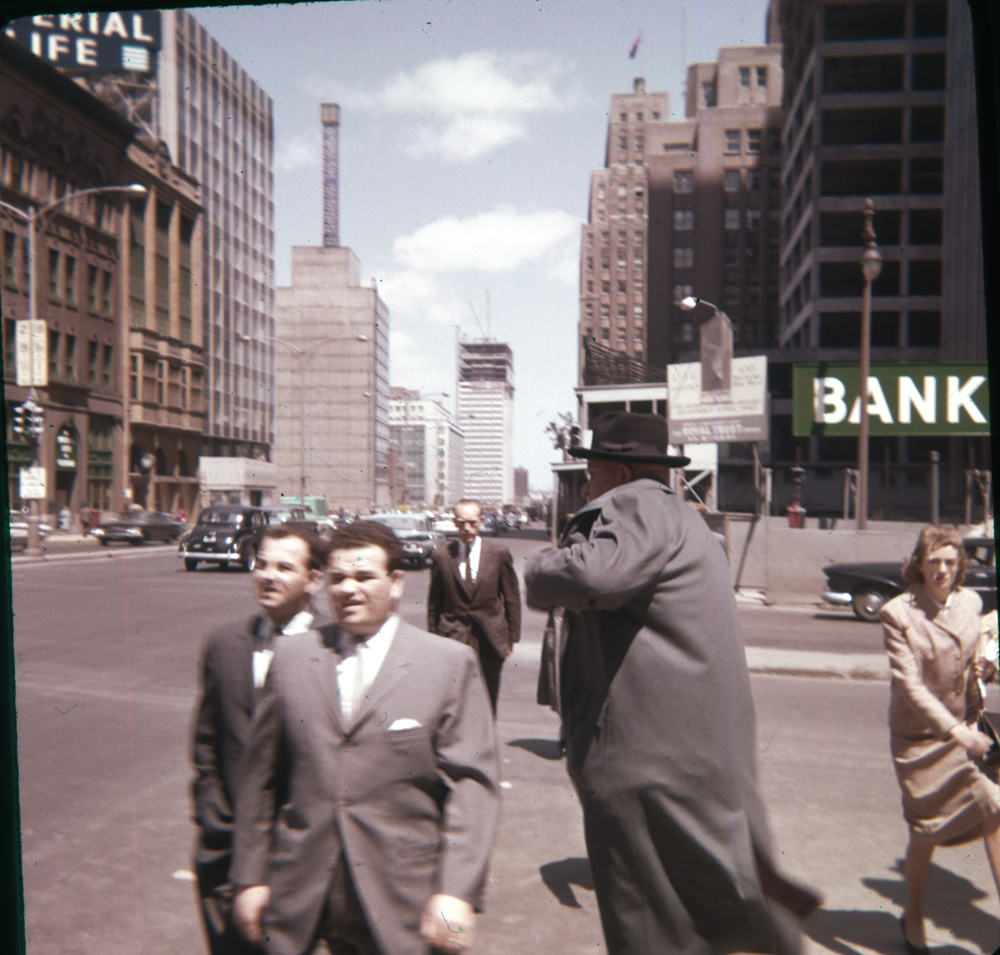
Construction of Bank of Commerce building from Dominion Square.


Bank of Commerce building - last girder to be placed (Dominion Bridge).


Bank of Commerce building construction from west on Dorchester Street.


Construction of Royal Bank Building (Place Ville Marie) from Dominion Square.


Canada Life building from west, on Dorchester Street.


June 14, 2019

May 1961 - New Skyscrapers for Montreal


This post looks at some old slides my father took during a couple of trips to downtown Montreal.

Many of the street and place names have changed since,
but I will use my father's captions as they were correct for that point in history.


This view looks at Dorchester East from Guy.
I'm relaxing on a concrete block which delineates a parking lot.


Place Ville Marie is seen from McGill College.

Family members looking in should note that the Volkswagen Beetle is not my father's first car.
It would be delivered in the months to come.
These trips were made by public transportation.


Dorchester East is seen from Drummond.


The top of the Bank of Commerce building.


St George's Church is seen beside the CPR's Windsor Station headquarters.


Place Ville Marie is seen from Dominion Square.

*  *  *

Montreal, Then and Now; Bryan Demchinsky; 1985; Montreal Gazette.

This interesting image from the 1950s comes from the book noted above.
Looking west, it shows the widening of Dorchester Street as it was transformed into a boulevard.


May 11, 2019

Lafontaine Park & Mount Royal - June 28, 1966


With school out at the end of June 1966 we visited
The Garden of Wonders at Lafontaine Park,
and also Mount Royal.

Noah's Ark was a structure surrounded by water.
In the windows could be seen some smaller animals.


To city kids, farm animals were as exotic as monkeys.


The animal environment 60 years ago was not as enlightened and natural as today's would be ...
assuming any animals would be shown for public curiosity and entertainment.

... There were not many elephant or killer whale documentaries on our small black and white TVs back then.


The bear cub environment seems to be influenced by the almost contemporary Yogi l'ours cartoons.

*  *  *

Mount Royal and Beaver Lake


Lunch time at Beaver Lake.
This was ten years before the 1 fois 5 concert.


The tour train at the Mount Royal chalet.


Beaver Lake as seen from the tour train.


A group portrait.


These two slide images don't fit exactly together.
This may be due to the convex edges of the snapshot camera lens,
... or my father may have used a slightly different vantage point for the second photo.


February 16, 2019

1942 CNR Turcot Yard and Lachine - photos by LC Gagnon


Like many photographers of the era, I think my father, LC Gagnon, was surprised by the speed of steam's demise in the 1950s on the CPR and CNR. Steam had 'always' been around and surely the railways would 'use up' their powerful new locomotives - rather than scrapping them after only 15 or 20 years of use. Steam locomotives were capital assets which were often in use (with technical upgrades added during rebuilding) for 50 years.

These circa 1942 photos were taken when my father was about 15. The cost of financing his hobby might have limited the number of photos he took back then.

If starting a second career, getting married and having a kid hadn't taken up his attention in the late 1950s, perhaps he would have taken many more photos during that era - when the future of steam was clear.

Back to the 1940s: 

My father also mentioned that it was generally unlawful to photograph trains during World War Two. During the two 'world wars' soldiers were often posted at the ends of key railway bridges - to prevent sabotage by enemy spies. I think the railways - particularly in the US - went through a similar period of paranoia after 9/11 when there were orders to report anyone by the tracks who was not 'dressed appropriately'. 

... I suspect this referred to the then-new practice of railway workers wearing high-visibility vests. But, by the same token, what terrorist would be so meticulous as to have prepared an engineer's cap with 20 'fallen flag' railroad company crests sewn on it? Surely traditional railfan garb was included in their definition of appropriate trackside dress.

Was my father concerned about wartime restrictions? 
Might he have ended up watching his trains from the POW camp at Neys? 
We just don't know.

If you have an interest in this period in history, hopefully you will find a few interesting details in these black and white prints - taken with an abdominally-braced box camera with a vertical viewfinder and a slow shutter.


These views of Turcot Yard, Montreal, were taken from Upper Lachine Road/St Jacques looking south.

My father noted that the locomotives in the foreground are positioned over the ashpits. Between runs, coal ash and some clinker would be cleaned from the fire by rocking the movable grates on which the coal was burned. The locomotive ashpans (beneath the grates) were then cleaned out into pits below. At large terminals, conveyor systems loaded the cooled ash into gondola cars for disposal. Rolly Martin started his work on locomotives as an 'ashpitman' at the Schreiber roundhouse.


Of course, this is the Turcot roundhouse. One reason that the railways converted to diesels so rapidly was because the latter required much less labour to keep them safe and running properly.

With steam, as an example, workers often had to get into still-warm fireboxes to look for steam leaks needing repair. A boiler failure over the firebox's crown sheet (usually from low boiler water and consequent metal failure over the fire) often destroyed the engine and killed the crew. 

The 'human experience' of locomotive terminal work involved working outside in the coldest, and inside in the hottest, weather. Roundhouse workers in summer toiled in a hot, noisy and dirty environment. With the war on, a number of younger railway employees joined the armed forces. The older, knowledgeable workers left behind would often have been the people popping into those fireboxes for an inspection.

With operations at a 'war tempo' transportation was always in short supply for the movement of troops, weapons, military supplies, and commodities such as grain and oil. Timing train movements to support the assembly of maritime convoys at Halifax's excellent natural harbour put further pressure on the eastern end of the CNR railway system.

Just behind the left side of the roundhouse you can barely see the roundhouse's water tank with its conical roof. You can spot the locomotive stalls in which locomotives have had their work completed - where their smokey coal fires are being built for the next run. No doubt, urban smoke regulations were relaxed during wartime. This gives you an idea just how unhealthy urban air was during the age of coal.


This view angles farther to west of Turcot Yard.
My father notes the presence of the Canadian [railway] Car Plant,
two streetcars (also on the far side of the yard),
and the end of the coaling dock (at the right edge of the photo).

*  *  *


Here is CNR 46 with an eastbound morning commuter train, whistling for the future 48th Avenue crossing.

In this era, the CNR track followed the route of today's Victoria Street through Lachine.

Above the running board, notice all the heavy air pump equipment to quickly recharge
the higher pressure passenger air brake system.
The ability to quickly recharge/release the air brakes after a station stop
kept the train on its tight rush hour schedule.


Here is a westbound afternoon commuter train in Lachine with a similar engine leading.

These little engines had been purchased by the Grand Trunk for this type of service.
They were absorbed into the CNR's roster, along with this railway line, in 1923.
Their wheel arrangement, rear pilot and rear headlight enabled them to operate at speed
(here in reverse) in either direction.

The choice of reversing westbound was perhaps due to the homeward run being less urgent
than the mission of getting commuters to work on time in the morning.
That tight schedule had to be maintained.

Looking at a home movie from the 1950s on video, I was amazed to see a running switch
performed with this type of consist at the western end of its run.


Here is CNR 6029 with a westbound passenger train in Lachine.


An eastbound CNR freight receives a clear signal in Lachine. Notice the two ice-cooled refrigerator cars on the head end. In this position they could quickly be switched out of the train consist for re-icing at Montreal or into another train to continue their journey without delay. The Wabash car of coal would not be handled with the same urgency. The four hatches are open on the second car.

Ice could be provided in a wide variety of particle sizes - depending on the preservation needs of the foodstuff or other freight being refrigerated. The cooling power (rate of melting) could be increased by mixing salt with the ice. 

And further refinements to cooling power could be made by opening the hatches on the ice bunkers - at each end. This could also be done to ventilate the car, particularly when charcoal-burning heaters were lowered into the ice bunkers during the colder months to prevent foodstuffs from freezing in transport.

Here are a few diagrams to help explain these cars better.

from: Handling Perishable Traffic, Circular 357; May 1938; Canadian Pacific Railway.

from: Handling Perishable Traffic, Circular 357; May 1938; Canadian Pacific Railway.

Below is a diagram showing the correct nomenclature along with inspection instructions.

from: Handling Perishable Traffic, Circular 357; May 1938; Canadian Pacific Railway.


... during a winter escape attempt from one of the POW camps along the north shore of Lake Superior, I read that a prisoner chose to hide in the ice bunker of a refrigerator car. While climbing into an ice bunker during a Lake Superior winter might signal a desperate need to escape by a 'not so bright' enemy ... It is also possible that the ice bunker had an operating charcoal heater in it. As long as one maintained access to fresh air, this would have provided a cozier ride than an empty boxcar!